Canon EOS M50 review
Summary
 The Canyon Eos M50 is an upper ingress-level mirrorless camera with a 24 Megapixel APSC detector, confident autofocus (for stills and 1080p video), small but crisp OLED view finder, excellent receiving set, and becomes Canon's first mirrorless with 4k video, a fully-jointed touch-screen, eye detection and silent shooting options. Woefully the 4k is of limited utilisation, employing a wicked browse and only working with less sure counterpoint-based autofocus. I'm also frustrated in that respect's zero USB charging, especially since the barrage is fairly unskilled. But these aside, the EOS M50 clay a highly compelling model with a pack together but comfortable body, effective touchscreen, industry-leading wireless, confident focalisation for 1080p video, and large colors out-of-tv camera. Indeed the M50 may represent inclined as an upper entranceway-level model, but I reckon it's Canon's most persuasive mirrorless to go out. Coupled with a hotshoe and mike input, the M50 will atomic number 4 as popular with vloggers as it is with those looking for an upgrade from smartphone photography. Recommended.
Buy it now!
Check prices along the Canon EOS M50 at Amazon, B&A;H, Adorama, operating theatre Wex. Alternatively get yourself a copy of my In private book Oregon treat me to a chocolate! Thanks!
Canon Eos M50 review -
- Written by
Presentation
The Canon Eos M50 is a mid-range mirrorless camera with a 24 Megapixel APSC sensor, viewfinder, to the full-articulated screen and 4k video. Proclaimed in Feb 2018, it's officially pitched between the entry-level EOS M100 and the step-up EOS M6, but actually sports whatever of the most advanced features in the series: it's the first Canon mirrorless to boast 4k video and a side-hinged CRT screen that can flip to any angle. Coupled with a hotshoe and mike input, the M50 is likely to be as popular with vloggers as it is with those looking for an upgrade from smartphone photography.
Same earlier models in the series, the M50 employs a 24 Megapixel APSC detector with Two-fold Pixel CMOS AF for smooth and confident refocusing, but contingent the Lens you fit, Canon's upgraded the autofocus area and operating theater the number of AF points. The Eos M50 also debuts Canyon's in vogue DIGIC 8 processor, allowing a slight boost in continual shooting (10fps with Single AF or 7.4fps with Servo AF), support for an additional compressed 'C-RAW' pick that's full declaration only around 40% smaller, eye detection, a new silent scene mode that employs an electronic shutter, and at last 4k video. Wrapping-up the specs are a 2.36 million dot OLED viewfinder, a fully-jointed 3in touchscreen that rear end leaf to face the field, and Wifi with NFC and Bluetooth, the last mentioned providing seamless connectivity and GPS location tagging with your phone.
Canon may be pitching the M50 as a mid-range model, only if you can live without the greater physical controls of the top-stop M5, I'd say the new features make the M50 the almost compelling in the series up to now and also a keen touch for Fujifilm's XT20 and recent XA5, let alone Sony's A6300 and Panasonic's Lumix G80 / G85. In my review I'll pick up how it measures-up and whether information technology's Canon's second-best mirrorless to day of the month! I'll start with two videos: a brief first-looks overview, followed by my in-depth review with Doug Kaye which is also getable as an audio podcast under. After this, I've detailed a total of the key features and capabilities.
Go over prices on the Canon EOS M50 at Amazon, B&H, Adorama, Oregon Wex. Or els get yourself a copy of my In Camera book surgery treat me to a coffee! Thanks!
Check prices on the Canon EOS M50 at Amazon, B&ere;H, Adorama, or Wex. Alternatively mother yourself a copy of my In Camera book surgery treat Pine Tree State to a coffee! Thanks!

The EOS M50 is styled like a miniskirt DSLR and available in dark-skinned OR white. It may have a clean compact and light polycarbonate consistence measuring 116x88x59mm and weighing 390g with battery, simply Canyon's designers should live commended on the ergonomics. The grip and erect thumb eternal rest are generously-sparrow-sized with a surface coating that ensures a secure and comfortable check. Meanwhile there may solitary be one control dial – around the shutter release – but it falls naturally under your index digit. There's also a small flash that's raised aside hand besides equally a hotshoe that lav accommodate external Speedlites surgery mount a microphone.
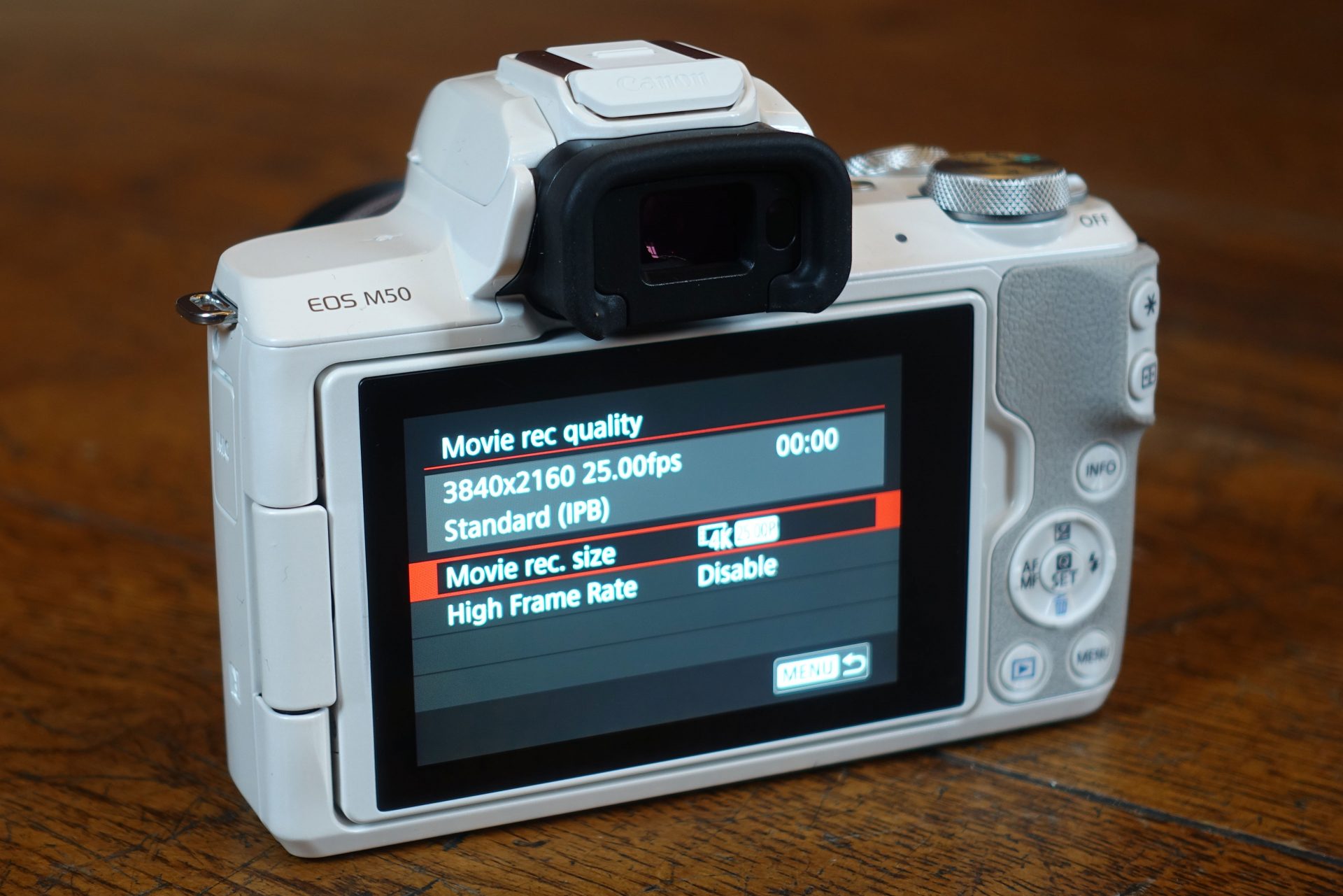
Round the back, the buttons are understandably itsy-bitsy, simply tiny raised edges on the quaternary crosskeys makes them surprisingly tactile and available to push; that said, I still base myself trying to bout a rear rack that wasn't there. Remember this is an upper debut-level camera with one insure dial. Luckily the touchscreen features an excellent exploiter interface.
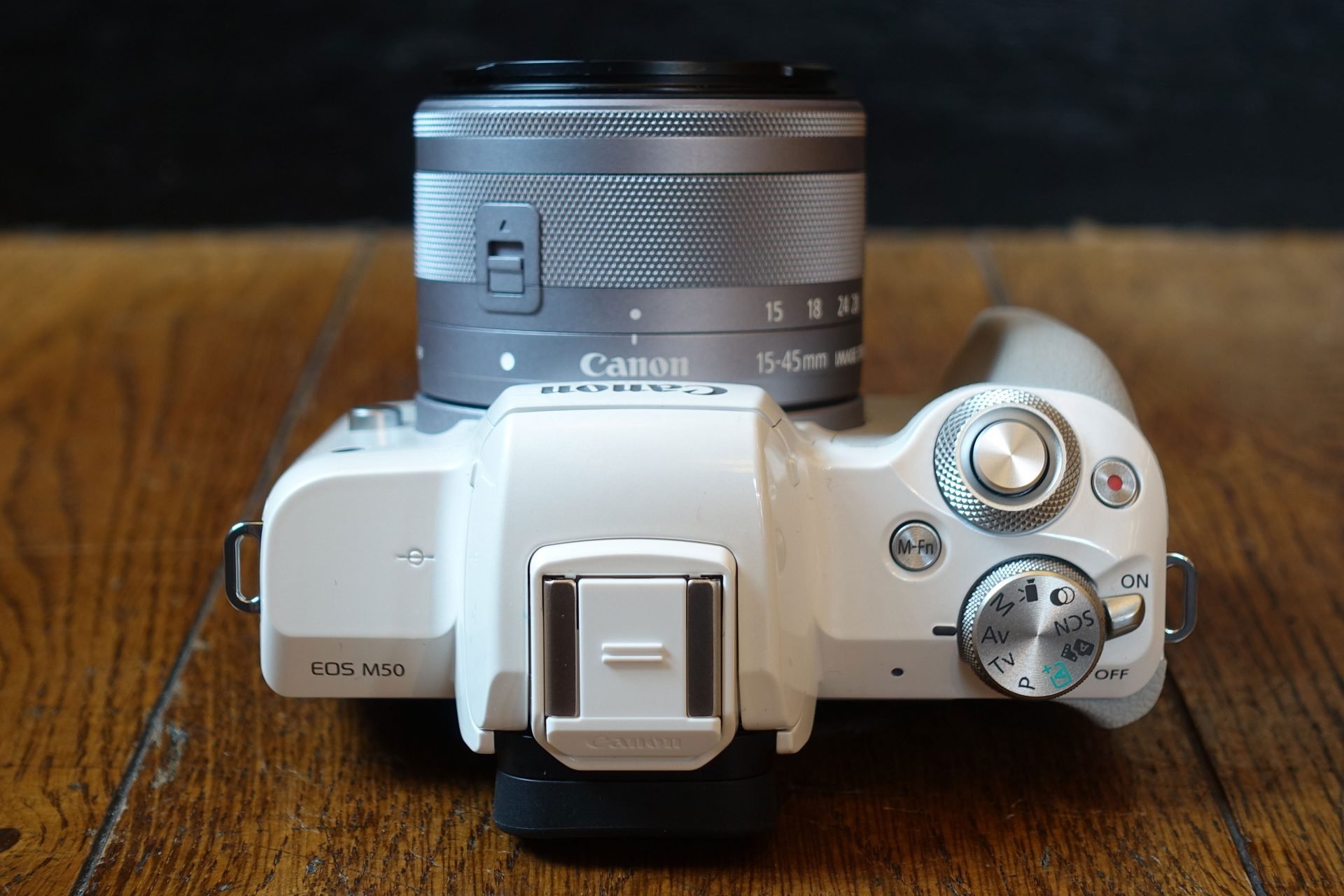
The EOS M50 becomes Canyon's second mirrorless television camera to feature a built-in electronic viewfinder. The image isn't huge, but the 2.36 Million dot OLED control panel dynamic it is crisp and elaborated. Like all lepton viewfinders you fire deploy altogether manner of shooting help including, on the M50, a live histogram, multiple-axis vertebra razing gauge, a variety of alignment grids, focus peaking and magnification, as comfortably as being able to film and playback video; No zebra patterns though.
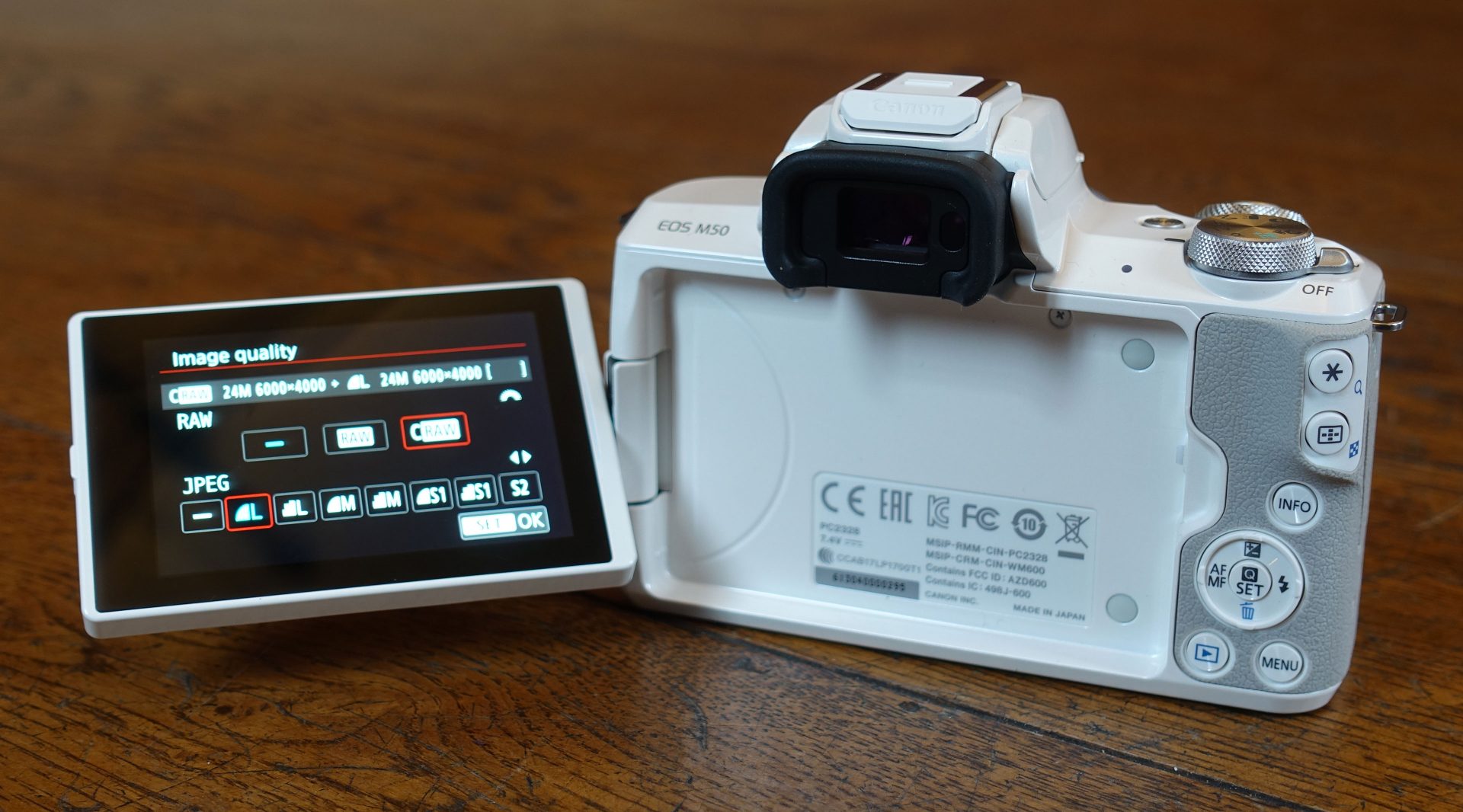
The EOS M50 is equipped with a 3in / 3:2 shaped touchscreen with 1040k dots. Information technology inherits Canyon's excellent contact user interface which lets you intuitively tap your elbow room direct virtually every fare or setting, besides as pinching, pushing and swiping your way through playback. Suffice it to say you can tap to refocus for stills or movies, and likewise use it A an AF sphere touchpad while composing through the finder. What makes the EOS M50's screen really special though is that IT's the front on a Canon mirrorless to be side-hinged and in full-articulated, flipping to almost any angle including nervy to face the subject for selfies OR vlogging. Information technology also means you can well compose at high or low angles when shooting in the portrait / tall orientation.

The EOS M50 is equipped with Micro USB and Micro HDMI (Type-D) ports, the last mentioned outputting a 1080p signal that can be clean so long as you're not transcription video at the time. In cardinal of the M50's biggest downsides though, the USB porthole cannot be used to charge the camera. As an alternative you'll pauperism to use the supplied AC charger and find an outlet to connect it. I know this is atomic number 102 different from other Canon mirrorless cameras to particular date, but the fairly modest battery life of the M50 coupled with the inability to topup over USB while out and close to caught me unstylish on several occasions. The moral? Buy a spare battery and retrieve to recharge every night. In damage of battery life, I typically managed around 150 shots per charge in widespread-utilize including a few minutes of video and wifi employment; for video alone, I recorded just over three consecutive half hr clips of 4k on a single charge with no overheating issues. Be warned though, the shelling indicator can rapidly fall from incomplete-way to flashing reddened. On the upside, the M50 does at least feature an external 3.5mm mike input, allowing you to upgrade the quality of your audio – a central gain for vloggers. I used it with my Rode Television Mic Pro, although I should add the quality from the built-in mics was also pretty good.

Like all Canon mirrorless cameras up to now, the Eos M50 is equipped with an EF-M mount for use with native EF-M mirrorless lenses; with an APSC sensor, all lenses have their field-of-view reduced by 1.6 multiplication, and then the standard EF-M 15-45mm kit zoom delivers an equivalent reportage of 24-72mm; I've pictured its coverage in a higher place.

The f3.5-6.3 focal ratio of the EF-M 15-45mm, like well-nig kit up zooms, is only capable of minor blurring if you're into shallow astuteness-of-field of honor personal effects. Here's a couple of examples at 15mm f3.5 (left) and 45mm f6.3 (right). If you deficiency greater blurring, you'll need a different lens.
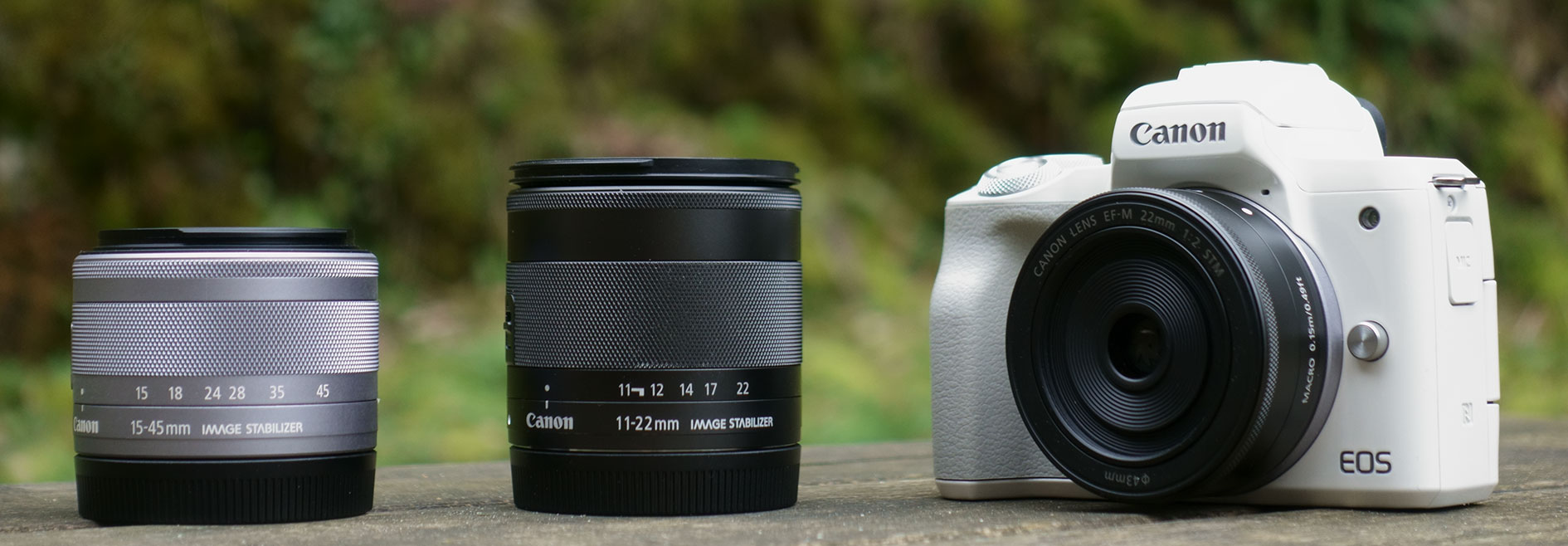
At the time of writing in Apr 2018, on that point were only seven aboriginal EF-M lenses, five of which are zooms and three of those are world-wide-purpose models. Ultra-wide fans are catered away the EF-M 11-22mm, while telephoto photographers can die for the EF-M 55-200mm. If you'Re into prime lenses, there's the EF-M 22mm f2 and the EF-M 28mm f3.5 Macro, but sadly nothing in the standard 50mm or 85mm equivalent length with a nice bright aperture to deliver shallow profundity-of-domain personal effects. I've depicted the M50 above on the right fitted with the EF-M 22mm, with the EF-M 11-22mm in the middle and the EF-M 15-45mm kit zoom on the outlying left.

Canon's solution to the currently modest selection of native mirrorless lenses is the EF to EF-M adapter which lets you rise any of the EF operating theater EF-S lenses free, and it includes a improved-in tripod foot to help balance larger models; I've visualized it here with the EF 50mm f1.8 STM lens, mounted on my Feisol TT-15 mini tripod. Adapted EF / EF-S lenses work same well happening the M50, with engorged support for autofocus and tracking; the solitary issue is they'atomic number 75 inevitably larger and heavier than rigorously necessary, and the adapter itself adds to the overall size of the package. So while it's a useful capability for owners of alive Canon DSLR lenses, I'd still alike to see more pure EF-M lenses exploiting the shorter flange to sensor distance and only needing to be disciplined for APSC.

The do good of the EF to EF-M arranger is opening up access to the broad EF lens system catalogue. Supra are two portraits loving the M50: on the left with the EF-M 15-45mm at 45mm f5.6 and on the right, the EF 50mm f1.8 STM at f1.8. Intelligibly the latter has the ability to deliver a much shallower depth of field and, linked with the field-step-dow from the APSC sensor, makes an abstract choice for portraits; find out my Canon EF 50mm f1.8 STM review for many details.
Like originally models in the series, the M50 employs a 24 Megapixel APSC sensor with Dual Pixel CMOS AF for smooth and capable refocusing, but depending on the lens you tantrum, Canon's upgraded the autofocus area and or the number of AF points. The early Dual Pel CMOS AF system covered roughly 80% horizontally and vertically, dividing the area into 49 points. Today when victimisation the EF-M 15-45mm, EF-M 11-22mm, EF-M 18-55mm and EF-M 22mm, the area remains the Same but the number of points doubles to 99. Fit the EF-M 28mm Macro, EF-M 18-150mm or EF-M 55-200mm (non to honorable mention most adapted EF-S or EF lenses), and the points addition boost to 143 diffuse across a broader area that covers 88% horizontally and a full 100% vertically. Disappointingly the EF-M 15-45mm kit zoom that'll most ordinarily be secondhand with the M50 International Relations and Security Network't one of those lenses that supports all the autofocus upgrades. Just IT still enjoys 99 AF points over an area 80% of the sensing element breadth and height. I'll talk more about the AF experience later in the review. If you prefer manual focusing, the Eos M50 also offers focus peaking assistance.

New to the Eos M50, thanks to DIGIC 8, is eye detection, amazingly another inaugural for a Canyon camera. This can be enabled if you experience face detection already activated, after which the photographic camera will look for come out of the closet the closest human eye and revolve around it; note Canyon suggested at the launch that it mightiness accredit non-human eyes, but it failed to do so on the dogs I pointed it at. Unequal Sony's mirrorless cameras, eye detection on the M50 North Korean won't work with continuous autofocus, but at least it's now available as a first pace. I took the portrait above exploitation the EF-M 22mm f2 at f2.

In another first for a Canyon, the M50 at present offers a Silent Modal value that employs an natural philosophy shutter to manoeuver without any undamaged in the least. It's deployed via a SCN planned though which means it's automatic photo only, and sadly it doesn't support continuous autofocus (as you're shooting), burst shooting Oregon eye-detection, nor does IT extend the reach of shutter speeds either, although at least there is the option to still record in RAW if desired. As so much the silent fashion is fairly basic on the M50, especially compared to rivals who've offered electronic shutter options for some time. But again at to the lowest degree it's immediately easy, and another gain of DIGIC 8.

The Silent Modal value is ideal for quiet environments like this shot I took inside Amiens Duomo with the EF-M 11-22mm; IT's so nice to take photos without any sound in these situations.

You may wonder why you wouldn't use electronic shutters all of the metre. Cured apart from the fact the EOS M50's Silent Mode limits your control over exposure and focus, there's the issue shared with most cameras where relatively slow sensor read-out means any subjects – or backgrounds – in motion can become skewed. In the three examples above, I was panning the camera to pursue the action while taking the photo. In modal exposure modes, in that respect's atomic number 102 problem just when using the electronic shutter in Silent Manner, the background has become horizontally extended owed to the sensing element readout. In more immoderate cases, vertical lines comparable streetlights come out to be leaning diagonally. Once again to be fair this is an put out that faces most electronic shutters so it's not a criticism of the M50 alone, but remains an important issue to be aware of.

DIGIC 8 in conclusion brings a compressed Untreated option. The M50's C-Rare mode captures chockablock declaration images but compresses their sizing by around 40%, thereby giving you the flexibility of post-processing without consuming atomic number 3 more space on your card. Typically my standard RAW files on the M50 measured round 33MB, compared to around 22MB for C-Unanalyzed versions of the same composition. Meanwhile, the standard RAW files employ a new CR3 format so you'll need to update your processing software program unless you're using Canon's own supplied applications; or els the M50 supports in-camera processing of RAW files in playback, allowing you to adjust the brightness, white balance, picture way, machine lighting optimizer, resound reduction, JPEG output quality, lens corrections and colour quad.


Turn the mode dial to Creative Filters and you can utilize Grainy B&W, Gentle Focus, Fish-eye, Pee Painting, Toy Tv camera, Miniature Oregon four different HDR effects. All but allow you to adjust the intensity of the force, although the goal consequence is but saved as a JPEG. You can even so hold any of the personal effects to existing JPEGs using the Q menu in playback, so if you're non 100% committed to an effectuate you could always shoot a normal version and make alternatives in playback later. If you'Re into movies, you can implement an optional miniature effect to video too, albeit only in 1080 / 25p / 30p. Sadly though there's still nary panorama function on the M50, not even panorama assistance.


DIGIC 8 allows the Eos M50 to shoot bursts at up to 10fps with single AF or adequate to 7.4fps with continuous AF. I tried shot my friend Ben cycling towards ME with the M50 fitted with the EF 85mm f1.8 at f1.8. Of the ternary AF modes available, I found Zoned area the least effective for an approaching cyclist. The single AF area established most effective so long as you could keep it positioned terminated the subject – something that can glucinium cunning with the small delay 'tween shots in the finder. The tracking or face observe AF way could also prove effective, but the former requires you to solicit along or select the craved topic which canful also raise difficult when they're in apparent motion and you're victimization a longer focal length. At the top speed I also managed 88 Declamatory JPEGs operating theatre nine RAW frames with continuous AF earlier the camera paused. That said, I still managed to take hold of utile focused sequences above 7fps and there's a selection above.

The EOS M50 is equipt with Wifi, complemented by NFC and Bluetooth to aid the connection. Canyon's receiving set implementation is united of the best around, with Bluetooth maintaining a low power link between your phone and camera, seamlessly geo-tagging images (if desired) and offering an instant remote control shutter control.


With your M50 paired with your sound over Bluetooth, you can set them improving to automatically geo-tag images atomic number 3 you shoot without whatever interaction; all you need to do is ensure the Canon app is lengthways along your earpiece, after which you'll learn a GPS ikon appear on the camera's screen moments afterwards powering information technology rising. I utilized it to geo-tag most of the images in my samples gallery. Here's one with the location entered into Google maps.

The Canon app also offers a five-needled Bluetooth remote control which works like a basic cable release. This lets you remotely actuate the shutter for stills or movies, as well as holding it open for Bulb long exposures. I old IT above to keep the shutter open for cardinal transactions. Bluetooth's speed means there may be zero loaded image or exposure control in this mode, only the connection is instant with no gaol, nor some hold with a Wifi association. If you favour air-filled removed control though, that's also available over Wifi.
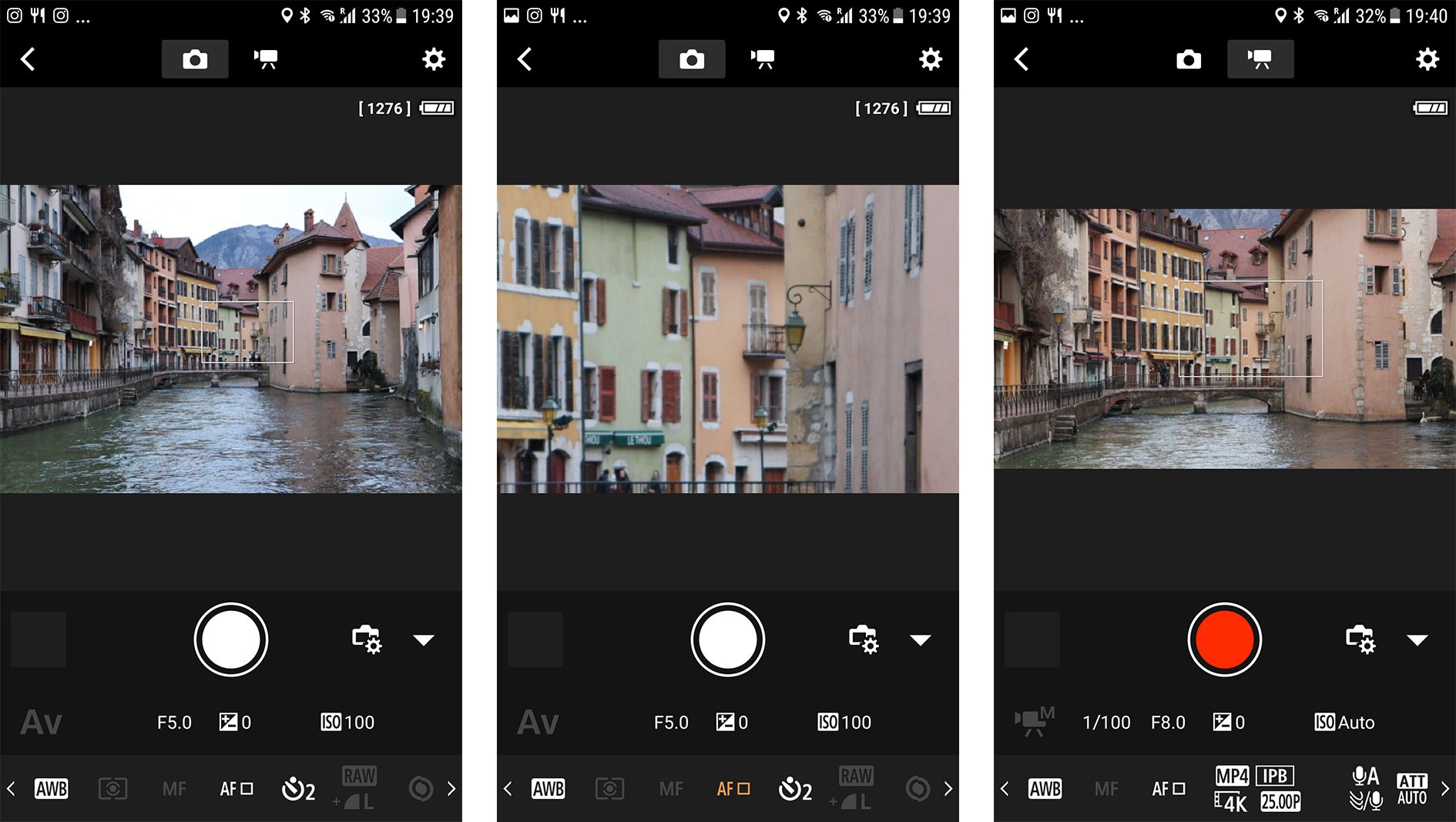
Bluetooth derriere also sort taboo the Wifi connection for you for browse and copying images or oblation a rumbling remote control experience with photo and focus control and a live image.

Just tap Images on Camera or Remote Live Shooting and the app will utilisation Bluetooth to enable Wifi happening the phone and camera, and take care of connecting them for you. IT's completely seamless and works a treat. You can even set the app to mechanically transfer images to your phone as you take them, or sync them onto a computer one time the camera's connected to the same Wifi electronic network. It's also possible to configure the camera to maintain a Bluetooth connection when it's switched-off, allowing you to remotely access the tv camera with your phone and copy images ended, even if the photographic camera itself is powered-off and stored in your bag; I did this numerous times to access and post images without having to level take on the M50 knocked out of my backpack.
Canyon EOS M50 movie mode
The Eos M50 terminate film 720 video at 50 operating theatre 60p, 1080 television at 24, 25, 30, 50 Oregon 60p, and in a first for a Canon mirrorless (or indeed any of their consumer models), 4k UHD at 24 or 25p. You can film for a second unsure of fractional an hour in whatsoever of these modes and I didn't see any over-heating issues. In terms of battery life, I managed just over three sequential half hr clips in 4k / 25p. In the video below I'll detail the movie mode and compare the quality and AF performance between the 4k and 1080p modes.
Above: Download the original file (Registered members of Vimeo only). I also have a adaptation filmed in 1080p.
There's also slow motion available in 720p at 100 or 120fps, depending on region, interpreted in-camera to 25 OR 30p for a four times slowdown. Note there's no audio recorded nor autofocus ready in this mood.
Above: Download the original file (Enrolled members of Vimeo alone). I also have a version recorded in 1080p.

Video recorded in 720p and 1080p uses the full sensor width with no reduction in the horizontal field of view (plane in 720 dumb gesticulate), merely 4k takes a 1:1 crop from the mid of the skeleton, resulting in a 1.56x reduction; this successively means information technology's hard to film optical lens in 4k, while the impermeable crop makes the M50's 4k mode more temptable to rolling shutter artefacts. In the image above, the outer edge of the scarlet frame indicates the coverage of 4k compared to 1080 when using the same lens.
If you film in 720p or 1080p, the M50 can deploy Dual Pel CMOS AF for smooth and confident refocusing without hunting. Woefully Dual Pixel CMOS AF is not available in 4k though, with the M50 lapse to a contrast-based autofocus system that's less confident with more visible hunting.
Higher up: Download the original file (Certified members of Vimeo only). I also have a interpretation filmed in 1080p.
As such, 4k on the M50 is of restricted employ compared to the 1080 and 720 modes: the severe crop and susceptibleness to rolling shutter conjugate with basic autofocus means it's best-suited to tripod-founded clips that don't need wide-angle coverage. That said, if the conditions are favourable, the M50's 4k footage can certainly look opportune, but it's non capable the quality or usability of 4k connected models like Sony's A6300 Beaver State the Lumix G80 / G85. Even Fujifilm's XT20 with its 10 minute clip limits proves more than on the table general for 4k. Thus IT's best to consider the M50 mostly as a 1080 tv camera, at which IT's fortunately very good.
Vloggers particularly testament sleep with the M50 for its combination of a decent-sized APSC sensor, excellent autofocus and look detection (at to the lowest degree for 1080p), microphone input and side-hinged touchscreen which buttocks flip to face the discipline. That said, I base the M50's built-in mics were already pretty unspoiled. I've collectively a vlogging demo in 1080p higher up.
The M50 also offers extra digital stabilization for movies with criterion and enhanced modes taking gradually tighter crops systematic to have some padding about the edges to work with. Enabling digital stabilisation can certainly glossy-dead some wobbles, and the enhanced mode flatbottomed Sir Thomas More so, but each comes at the cost not just of a tighter field-of-view, merely also reduced quality ascribable the picture element-wrangling.
4k video in particular suffers the most as the M50 already starts with a 1:1 craw when thither's no digital stabilisation, so taking a farther crop means capturing less than 4k resolution and scaling information technology up. Then there's the bear upon of the extra crop: in 4k, you'rhenium looking 1.56x without whole number IS, 1.75x with digital IS and a whopping 2.2x with the enhanced mode, all on top of the sensor's 1.6x thanks to its APSC size. So even with the widest EF-M 11-22mm zoom at 11mm, filming in 4k on the M50 will transform it into a 28mm equivalent without whole number IS, and 31mm or 39mm with integer IS or increased IS respectively. In the meantime the EF-M 15-45mm kit whizz along at 15mm becomes all over 50mm equal in 4k with increased stabilisation.
Above: Download the daring register (Registered members of Vimeo only).
Finally, the M50 offers timelapse video facilities with the option to encode the effect in 1080p surgery 4k. There's three preset scenes designed for capturing subjects like people walking or clouds in a flip, or you terminate move in custom settings. Above is an example I filmed using the archetypal picture, capturing 300 images at three second intervals; I used the EF 85mm f1.8 here for a thin perspective and knee-deep depth-of-field.
Canon EOS M50 quality
Now it's time to take a closer look at the photo timber of the M50, starting with my quality page which shows how the camera performs crosswise its ISO sensitivity range in JPEG and RAW. Then check out my sample images, confiscated with a kind of lenses, before heading to my verdict Page!
Jibe prices on the Canon EOS M50 at Amazon River, B&H, Adorama, or Wex. Alternatively flummox yourself a copy of my In Tv camera ledger surgery treat me to a coffee! Thanks!Pages: 1 2 3 4
Canon EOS M50 review
Source: https://www.cameralabs.com/canon-eos-m50-review/

Posting Komentar untuk "Canon EOS M50 review"